
Motto: “Ducit Amor Patriae – Led by Love of Country” (Inscription on the emblem of the 131 Infantry Regiment, US Army National Guard)
Every year on 1st December, Romanians celebrate their National Day. On 1st December 1918, at the end of the First World War, Romanians in Transylvania, representing the absolute majority of population (Fényes Elek, a 19th century Hungarian statistician, estimated in 1842 that in the population of Transylvania 62.3% were Romanians), decided to unite with Romania. It was the completion of The Great Union, as on 27 March and 15 November 1918 the National Assemblies of Bessarabia and Bukovina – both ethnically and historically Romanian provinces – had also decided the union with the Kingdom of Romania. Prime Minister Ion I. C. Brătianu told the Transylvanian delegation that had brought the Act of Union to Bucharest: “We have been waiting for you for a thousand years and you have come so that we may never be separated again. There are moments in the life of a nation when happiness is so great that it redeems entire centuries of pain.”
17 million soldiers and civilians were killed in WWI. The dimension of the tragedy was described by the Canadian poet and military doctor John McCrae’s, in his poem “In Flanders Fields”: “In Flanders fields the poppies blow / between the crosses, row by row”. Initially neutral, in August 1916 Romania was requested by France and Great Britain to enter the war, in order to relieve the huge German pressure on the Western front. Based on the Allied Powers’ promise to launch an offensive in Greece and to provide military assistance against an attack coming from the South of the Danube River, Romanian troops crossed the Carpathian Mountains into Transylvania, where they were received as liberators. As the Romanian Army advanced rapidly, field marshal Paul von Hindenburg, Chief of Staff of the German Army, wrote: “It is certain that so relatively small a state as Romania had never before been given a role so important and, indeed, so decisive for the history of the world at so favorable a moment. Judging by the military situation, it was to be expected that Romania had only to advance where she wished to decide the World War.”
But there was no Allied offensive in Greece and no military support on the Danube, and Romania found itself simultaneously attacked from three sides. The Romanian Government was forced to withdraw from Bucharest to Iași, in Moldova. To protect the retreat, a fierce resistance was organized on the peaks of the Carpathians, near my native town of Câmpulung Mușcel. And to make the defense impenetrable, the Romanian High Command brought in the 70th Infantry Regiment formed by inhabitants of the region, whose families were living in the villages just behind the frontline. In a clash that can be compared to the Battle of Thermopylae, they successfully stopped the advance of the more numerous and better equipped German Alpine Corps. A reminder of the epic battles that took place there in the autumn of 1916 are the relics of over 2300 soldiers who rest for eternity in the Mausoleum on the Mateiaș Mountain. On clear days, I can see it from my yard.
Then, in July 1917 the Romanian Army broke the Austro-Hungarian front in the Battle of Mărăști. German general Von Mackensen promptly launched a counterattack at Mărășești, announcing his superiors: “Gentlemen, see you in two weeks in Iași!”, while the Austro-Hungarian army attacked on the Oituz Valley; both offensives were repelled by the Romanians. 800,000 Romanian soldiers fought on the Entente side and 335,706 of them made the ultimate sacrifice, representing 6% of all military deaths in the WWI. Among them, the 2344 Romanian war prisoners who died in Alsace (France). The Great Union and modern Romania were built on their bones, too.
The Union of 1st December 1918 accomplished the centuries-old national dream of bringing in a unitary state all Romanians living around the Carpathian Mountains. After The Great Union, Romania became a country defined by diversity, multiculturalism and democratic values. The Union also consecrated Romania’s attachment to the principles of respect for persons belonging to national minorities and of peaceful relations with other countries. In 1919 the country became a founding member of the League of Nations, in 1955 was admitted to the United Nations, in 1993 became a member of the Council of Europe, in 2004 joined NATO, and in 2007 acceded to the European Union. Today, Romania has diplomatic relations with 187 other states and a large diplomatic network on five continents. It is a party to more than 100 conventions of the Council of Europe, a model of cultural diversity, a promoter of peace and security in Europe and beyond.
Romanians’ history had its first lines carved in stone 1900 years ago, on Trajan’s Column in Rome, commemorating the Dacian Wars, and since then they remained without interruption within the same geographical space. As the great historian Nicolae Iorga (on 27 November 2025 we commemorated 85 years since his tragic passing away) wrote: “With the sword in hand, guarding all the horizons, and when the steel of sword broke for a moment, only to be reborn again out of the blue, we opposed to brutality the thin weapon of our intelligence. And behold, we are still at home!”
Today again, in a turbulent geopolitical context where the international challenges are problems without passports and without borders, Romania must once again manage the risks of a large-scale armed conflict near its borders, and to strengthen its national resilience. In an era of rapid changes which require continuous adaptation, the membership to EU and NATO, the Strategic Partnership with the United States, and the cooperation with international partners, remain defining features of its foreign policy.
As the President of Romania, Nicușor Dan, pointed out on 26 November, when he presented to Parliament for approval the National Defense Strategy for the period 2025-2030: “The central concept is that of solidary independence. Independence in the sense that the actions of the state administration must be commensurate with the way the people here see the world, the affirmation of this identity and the interest that corresponds to this identity. Solidarity, meaning our respect for all partners and for all the commitments we have made in this increasingly complex world.”
The Strategy reflects the vision of a modern and secure Romania, which enjoys peace, a state built around its citizens, in the service of their fundamental rights and freedoms, with transparent and integrity institutions, oriented towards the public good. This approach, which may be seen as a social contract between the Romanian State and its citizens, reminds me of the words of US President Ronald Reagan: “How can we love our country and not love our countrymen; and loving them, reach out a hand when they fall, heal them when they’re sick, and provide opportunity to make them self-sufficient so they will be equal in fact and not just in theory?” (The Ronald Reagan Presidential Foundation & Institute).
The Romanian diaspora too, is part of this social contract; just like in 1918, the success of a national project depends on the participation of all Romanians, both those inside and outside the national borders. Like a faithful mirror of those who remained in the country, diaspora encompasses the entire spectrum of the Romanian soul and values. Romanians abroad have become an integral part of the countries where they live, but their voice remains equally important for Romania, which can only be prosperous through the synergy of all its resources of intelligence and professionalism. More than 100 years ago, the same Prime Minister Ion I. C. Brătianu left us the following aphorism: “The soul of Romania can only manifest itself in national unity”. This statement remains just as valid today. By honoring the realm, we honor our future, as a nation.
Finally, the words of the Secretary General of the Council of Europe, Alain Berset, delivered on 1st December at the celebration of Romania’s National Day in Strasbourg: “Romania is the Carpathian Mountains. The Danube Delta. Some of Europe’s most extraordinary natural landscapes. But Romania is above all a people — resilient, outward-looking, and deeply European. A people who fought for democracy. Who knows history’s pressure points. And who lives on our continent’s strategic edge… Romania’s contribution to Europe has taken on many forms. Each time I enter the hemicycle, I pass Brancusi’s sculpture “The Prayer”. I think of Romania. A human figure reduced to what is essential. Quiet. Vulnerable. Dignified. That simplicity speaks to art. And it speaks to democracy.”
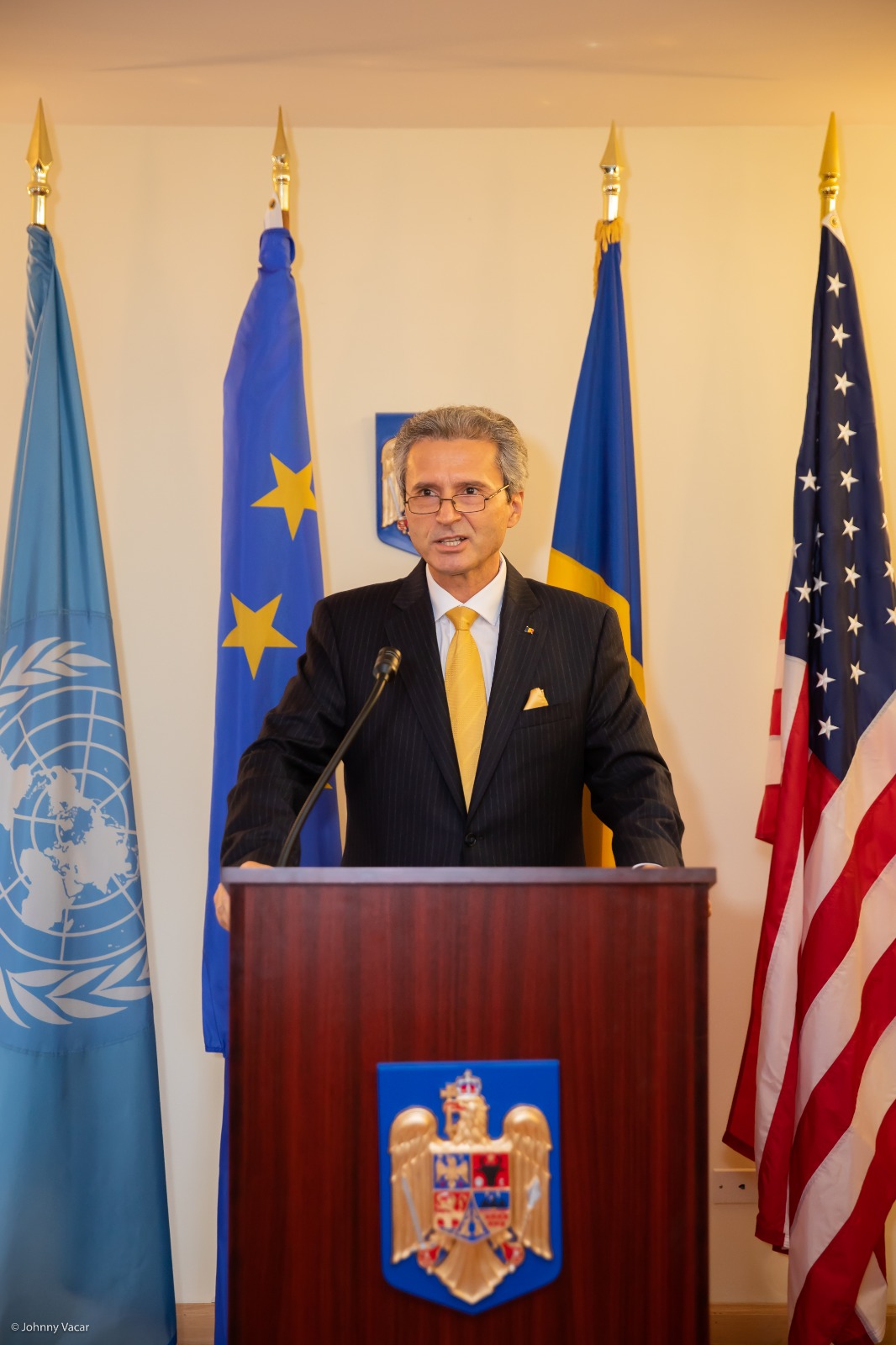
Dr. Ion I. Jinga
Note: The opinions expressed in this article do not bind the official position of the author.